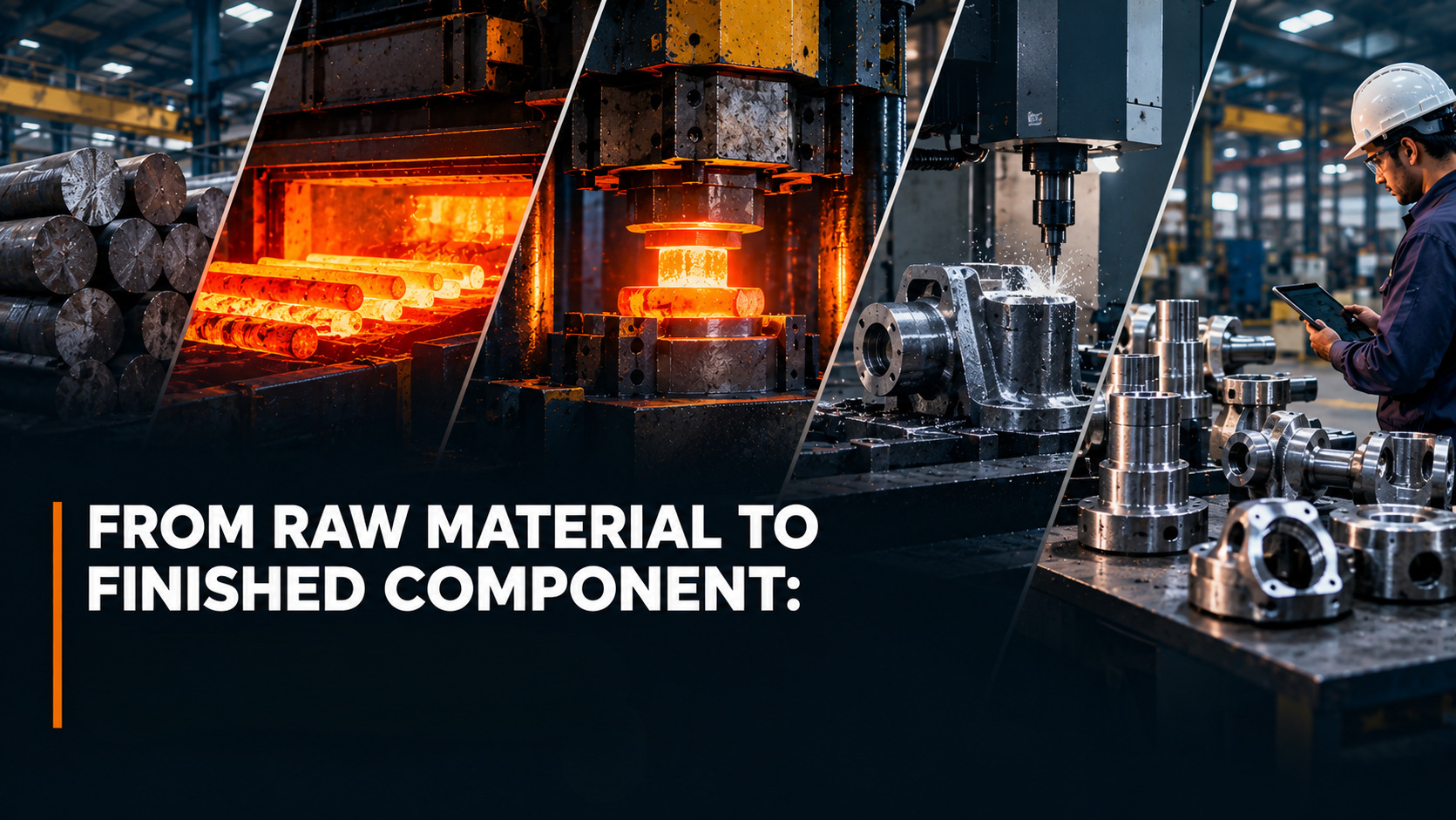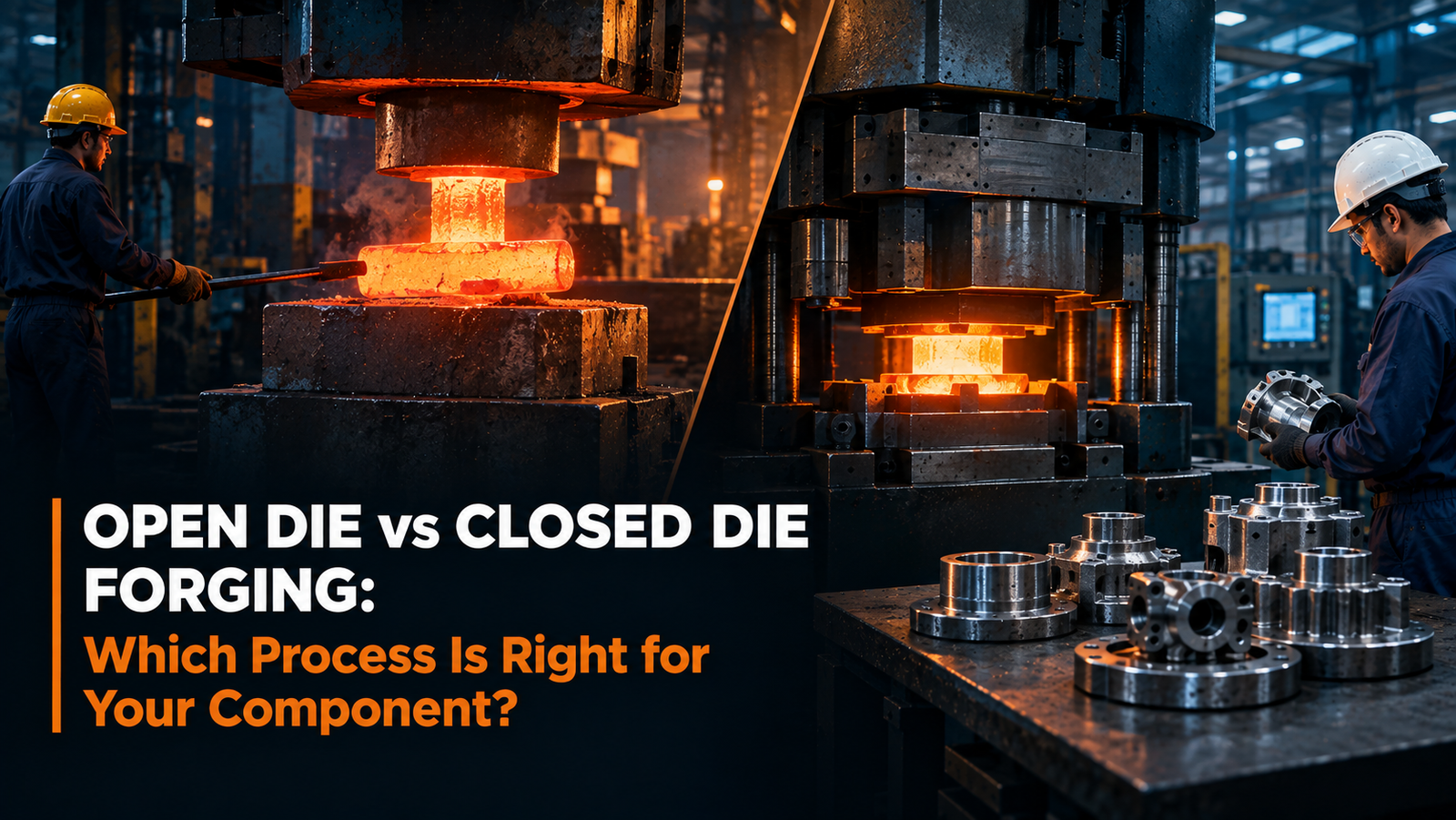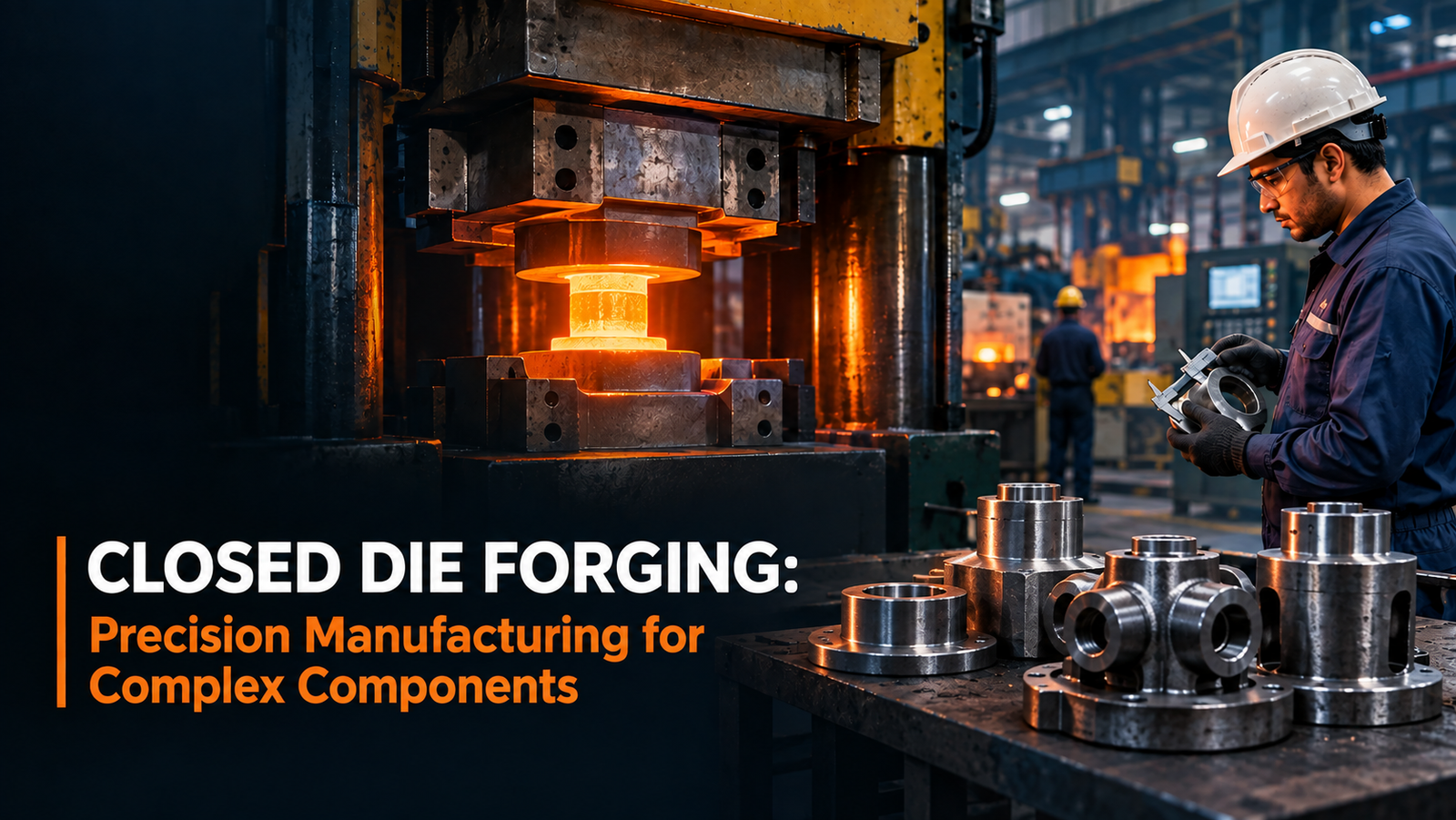
Forging is widely used for components that must perform under demanding mechanical conditions. During forging, controlled deformation can improve the internal structure of the material and help produce components with desirable mechanical characteristics.
The Metallurgical Advantage: Grain Flow & Density
When engineering parts face severe cyclic loading, continuous vibration, heavy shock, or extreme operating pressures, casting or subtractive bar machining often fails to deliver the required longevity. Forging addresses these vulnerabilities at a microscopic, crystalline level.
Under repeated, heavy compressive deformation—whether executed via open die hammers or closed die impression presses—the internal dendritic cast structure of the billet is completely broken down and recrystallized. Porosity, gas pockets, and microscopic voids are fused together. Crucially, the metallurgical grain flow lines of the metal are forced to follow the contours and geometric profile of the finished part, producing exceptional resistance against impact and directional fatigue.
Major Advantages of Forged Components
Compared to alternative metal-forming techniques, forging provides distinct structural and economic advantages for mission-critical parts:
Superior Strength-to-Weight Characteristics
Forged components can provide excellent strength-to-weight characteristics.
Because the forging process dramatically densifies the steel and eliminates internal micro-voids, forged parts attain higher tensile and yield strength without requiring excess bulk. Design engineers can reduce component weight and material thickness while safely maintaining or exceeding critical load safety factors.
Long-Term Operational Durability
Forging is suitable for applications exposed to demanding loads and operating conditions.
The refined grain matrix gives forgings superior toughness, higher impact resistance, and elevated fatigue life. Under abrasive environments, repeated thermal cycling, or continuous stress reversals, forged components resist crack propagation and premature fatigue far better than castings or welded assemblies.
Robust Structural Integrity
The controlled deformation process can help produce robust component structures.
Freedom from internal gas porosity, alloy segregation, and shrinkage cavities ensures uniform metallurgical response during downstream heat treatment, quenching, and induction hardening. Ultrasonic testing (UT) consistently confirms 100% sound volumetric density across the entire cross-section.
Repeatable Mechanical Performance
Consistent manufacturing processes contribute to repeatable component performance.
Predictable material flow and controlled temperature cycles eliminate the unexpected localized weaknesses often found in cast parts. In critical industrial applications where an unplanned component failure could cause costly plant downtime or safety hazards, forging provides dependable, repeatable service life.
Forging vs. Casting vs. Machined Bar: A Performance Comparison
| Feature | Forged Components | Cast Components | Machined Bar Stock |
|---|---|---|---|
| Grain Flow Pattern | Continuous, follows shape contours | Random, non-directional dendrites | Straight grain lines cut by machining |
| Internal Porosity | Completely eliminated under pressure | High risk of shrinkage & gas voids | Sound center, but surface grain exposed |
| Impact Toughness | Maximum Charpy impact energy | Low to moderate, prone to brittle cracks | Moderate along longitudinal axis only |
| Strength-to-Weight | Optimized, allows thinner sections | Heavy walls required to compensate | Standard; high material waste |
| Heat Treatment Response | Uniform through-thickness hardness | Irregular due to alloy segregation | Predictable, but anisotropic |
Critical Industrial Applications
Due to their unyielding structural integrity, forged parts serve as the backbone of high-stress industrial systems globally:
- Automotive Systems — Heavy-duty crankshafts, transmission gears, steering knuckles, wheel hubs, and differential pinions.
- Heavy Machinery — High-load pivot pins, hydraulic cylinder clevises, heavy tie-rods, and forged brackets.
- Power Transmission — High-torque drive shafts, bull gears, planetary carrier hubs, and flexible couplings.
- Construction Equipment — Excavator bucket tooth adapters, track linkages, sprockets, and articulated joint pins.
- Industrial Machinery — High-pressure valve bodies, pump shafts, turbine discs, and mixer rotors.
- Defence Applications — Heavy armored vehicle suspension arms, ordnance housing components, and high-impact drive shafts.
- Energy-Related Equipment — Wellhead flanges, blowout preventer blocks, pipeline manifolds, and wind turbine generator shafts.
The Forgewell Approach
Forgewell combines forging with downstream processes such as machining, heat treatment and inspection to deliver components according to customer requirements.
By integrating Open Die and Closed Die forging operations with an in-house heat treatment facility, modern CNC machine shop, and rigorous NABL-accredited metallurgical testing, Forgewell Industries delivers end-to-end component solutions that streamline procurement, reduce risk, and guarantee compliance with global quality standards.
Forgewell Industries — Strength Forged. Precision Delivered.