A forged component is rarely completed in a single operation. The final product may involve several interconnected manufacturing stages, each contributing to its performance and dimensional accuracy. Forgewell Industries brings together multiple stages of this manufacturing journey.
The 7-Step Manufacturing Journey
Delivering high-integrity engineered components requires careful planning, strict process control, and metallurgical expertise at every touchpoint. Here is how Forgewell takes components from raw ingots to precision-machined, ready-to-assemble products:
Raw Material Selection & Verification
The manufacturing process begins with appropriate raw material selected according to component requirements.
Forgewell sources certified prime steel grades (Carbon Steel, Alloy Steel, Stainless Steel) directly from leading audited mills such as SAIL, SAARLOHA, Mukand, and Nippon Steel. Each heat lot undergoes positive material identification and spectroscopic verification against Mill Test Certificates (MTC) to guarantee that chemical composition matches client specifications prior to cutting.
Precision Cutting
The material is cut to the required starting dimensions.
Using automated, high-precision horizontal and vertical band saw machines, ingots and round bars are cut into precise billet lengths and exact calculated slug weights. Strict cutting tolerances ensure uniform weight distribution, reduce scrap, and provide the exact volume required for optimal plastic deformation during forging.
Heating & Forging
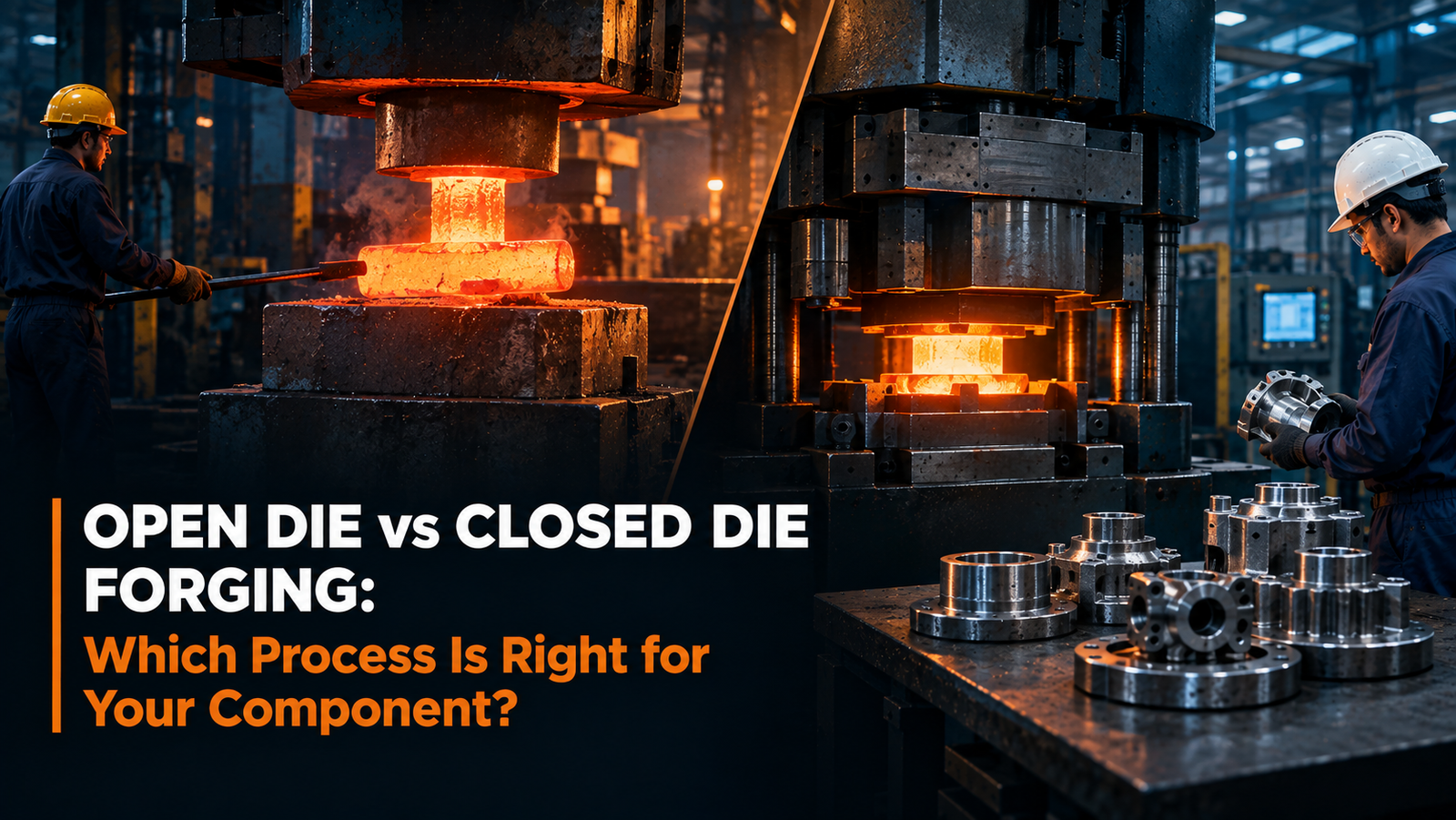
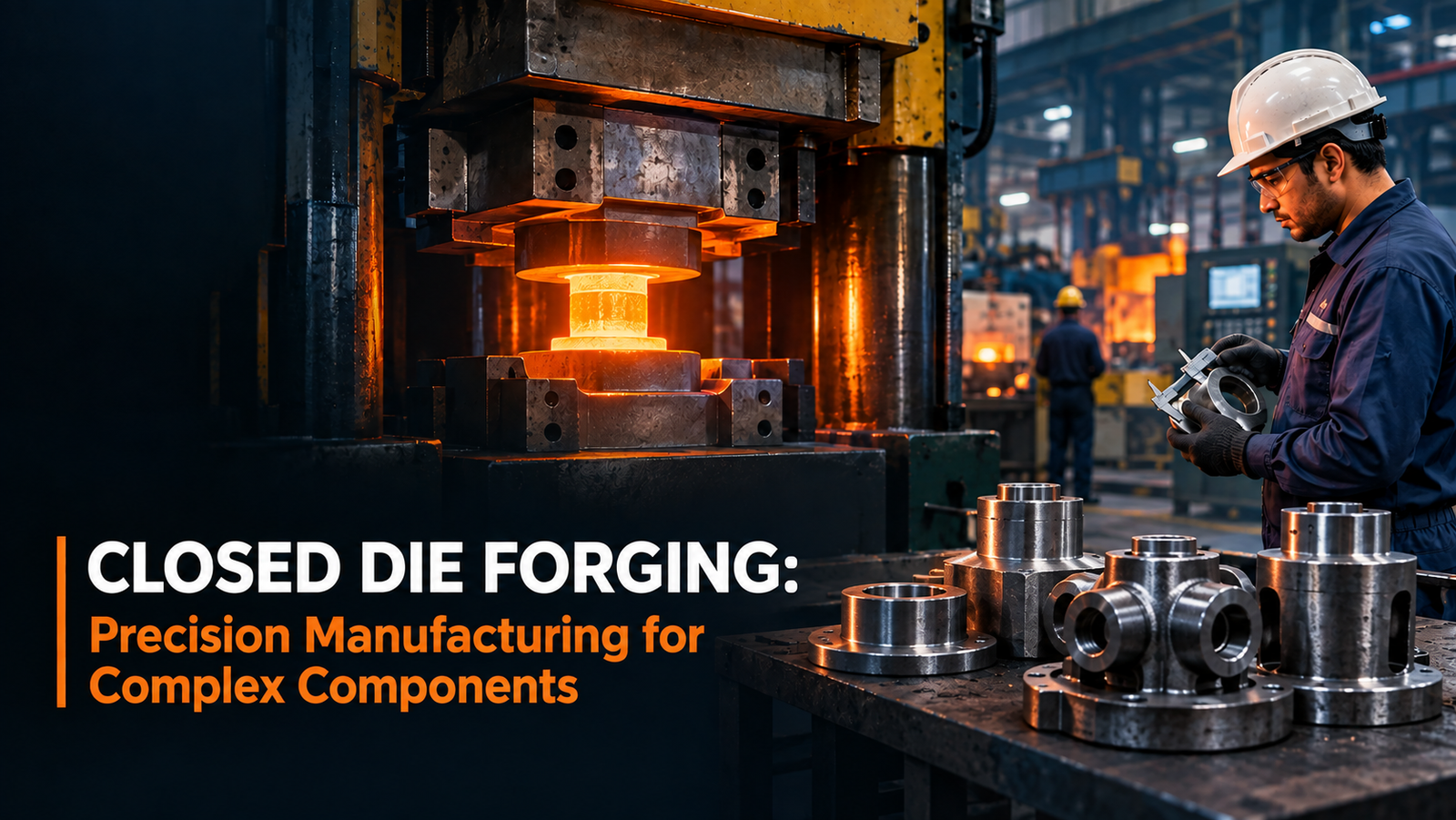
The material is heated and shaped using either Open Die Forging or Closed Die Forging.
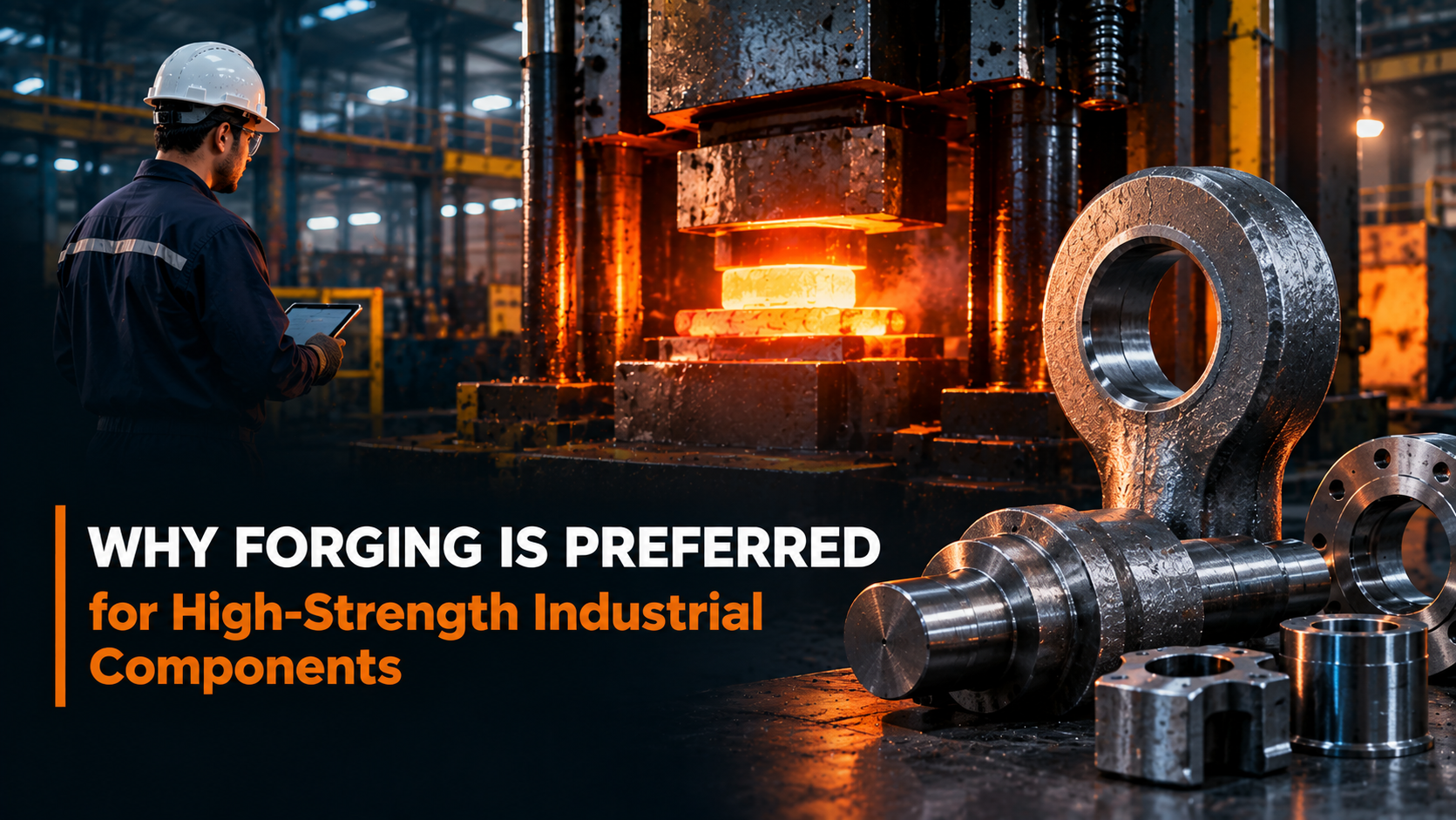
Workpieces are heated in digitally calibrated furnaces to precise forging temperatures. Depending on part size, geometry, and batch quantity, components are shaped using our pneumatic power hammers or closed die presses. Compressive plastic deformation refines the internal crystalline grain structure, closes internal porosity, and aligns metallurgical grain flow along component stress paths for exceptional mechanical toughness.
Rough Machining (Proof Machining)
Excess material is removed and important surfaces are prepared for subsequent processes.
Heavy-duty lathes and proof-machining centers remove the outer forged oxidation skin and decarburized layers. Rough machining brings the forging close to baseline envelope geometry, relieving superficial stresses and preparing clean surfaces essential for accurate ultrasonic testing and uniform heat penetration in subsequent heat treatment cycles.
Controlled Heat Treatment
Heat treatment is performed where required to achieve specified mechanical properties.
Components undergo designated thermal cycles — including Normalizing, Annealing, Quenching, and Tempering — in calibrated furnaces equipped with multi-point temperature data loggers. This crucial step optimizes grain refinement, relieves internal forging stresses, and tailors tensile strength, yield strength, elongation, and impact toughness to exact engineering requirements.
Precision Finish Machining
Precision machining brings the component to its final dimensional requirements.
Our dedicated machine shop utilizes advanced CNC turning centers, vertical milling, radial drilling, and grinding equipment to machine features to micron-level tolerances. From intricate gear profiles, keyways, and tapped holes to bearing journals with critical surface finishes (Ra values), components emerge ready for immediate assembly line integration.
Quality Inspection & Certification
Inspection verifies dimensional, mechanical and other specified quality requirements.
Prior to dispatch, components pass stringent quality validation. This includes 100% Non-Destructive Testing (Ultrasonic Testing to ASTM A388, Magnetic Particle Inspection, Liquid Penetrant Testing), dimensional checks with calibrated verniers and coordinate measuring equipment, and mechanical testing (Brinell hardness, tensile, Charpy impact). Every order is accompanied by comprehensive EN 10204 3.1 inspection certificates.
Process Overview: From Ingot to Finished Part
| Stage | Process | Key Purpose | Quality Deliverable |
|---|---|---|---|
| Step 1 | Raw Material | Certified prime steel sourced to grade specification | MTC & Spectro Verification |
| Step 2 | Cutting | Band sawing to precise starting lengths and slug weights | Dimensional & Weight Checks |
| Step 3 | Forging | Heating and shaping via Open Die or Closed Die | Continuous Grain Flow |
| Step 4 | Rough Machining | Scale removal and proof envelope preparation | Surface Cleanliness & UT Prep |
| Step 5 | Heat Treatment | Controlled heating & cooling for mechanical properties | Hardness & Microstructure |
| Step 6 | Finish Machining | CNC turning, milling, and fine tolerance finishing | Print Drawing Tolerances |
| Step 7 | Quality Inspection | Comprehensive NDT, dimensional, and mechanical audits | EN 10204 3.1 Certification |
One Manufacturing Partner: The Integrated Advantage
Managing multiple manufacturing stages through a coordinated supply chain can simplify communication, scheduling and quality control. Forgewell Industries provides an integrated approach covering forging, machining, heat treatment and inspection.
Fragmented Sourcing Risks
- Divided accountability between forge shop and separate machine vendors
- Costly transit time, freight charges, and intermediate handling damages
- Difficulty tracing heat numbers and quality discrepancies across facilities
- Prolonged lead times when coordinating conflicting vendor production queues
Forgewell Integrated Advantage
- Single point of contact from drawing review to final dispatch
- Synchronized scheduling cutting lead times by days and weeks
- End-to-end traceability under ISO 9001:2015 certified governance
- Ready-to-assemble components directly feeding your production lines
From raw material to finished component — Forgewell helps simplify the manufacturing journey.