Choosing a forging supplier is more than comparing prices. The right manufacturing partner should have the capability, quality systems and process knowledge required for your application.
In heavy engineering, defence, automotive, power generation, and oil & gas sectors, forged components serve as the mechanical backbone of high-load assemblies. When a high-pressure valve body, rotating shaft, or transmission ring experiences intense cyclic fatigue, torsional shock, or elevated temperatures, metallurgical integrity is paramount. Selecting a supplier based solely on the lowest initial per-kilogram quotation often proves costly down the line through hidden scrap rates, delayed deliveries, poor ultrasonic sound transmission, and premature field breakdowns.
To establish a resilient, high-performance supply chain, engineering buyers and procurement heads should evaluate prospective forging manufacturers across six critical pillars:
1. Manufacturing Capability
Check whether the supplier offers the required forging process, such as Open Die Forging or Closed Die Forging.
Process Alignment
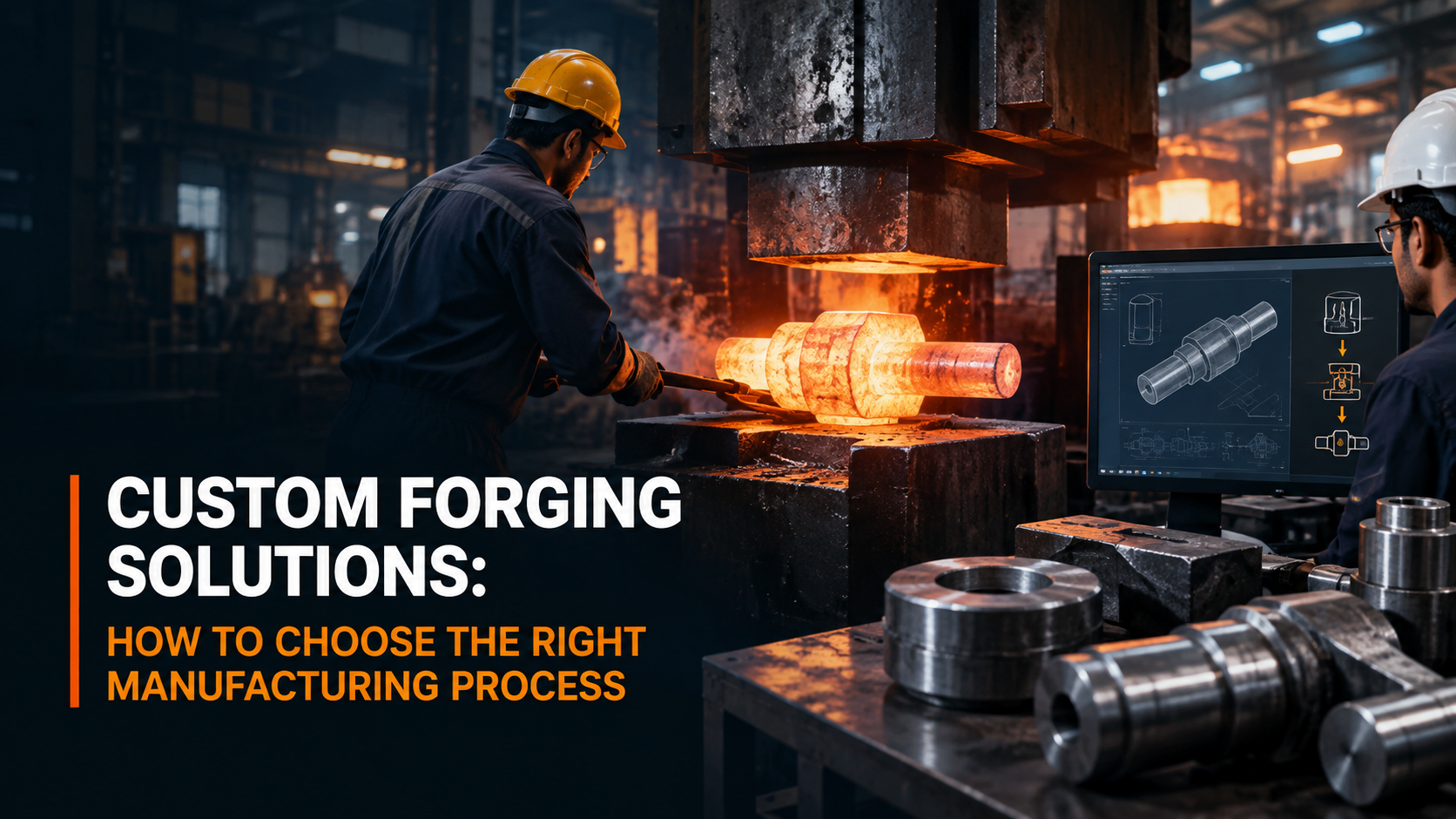
Every forging method serves distinct production volumes, geometries, and tooling budgets. Open Die Forging is ideal for custom stepped shafts, large rings, hollow cylinders, and heavy blocks in low-to-medium batch sizes without expensive dedicated die tooling. Closed Die Forging, by contrast, suits high-volume, uniform small-to-medium parts where tooling investment is amortized over thousands of units. Ensure your supplier’s core equipment matches your technical and commercial volumes.
2. Component Capacity
Consider whether the manufacturer can handle your component's size, weight and geometry.
Equipment & Dimensional Envelope
A partner’s hammer tonnage, manipulator capacity, and furnace volume determine the physical limits of what they can produce. Verify maximum billet starting weights, maximum forged diameters (e.g., up to 800 mm dia), piece weights (e.g., up to 500 kg per piece), and maximum shaft lengths. Exceeding equipment limits causes improper center consolidation, incomplete reduction ratios, and residual core porosity.
3. Quality Systems
Quality certifications, inspection systems and testing capabilities are important indicators of manufacturing discipline.
Certified Discipline & Traceability
Look for recognized third-party accreditations, such as ISO 9001:2015 certified by TUV NORD, alongside NABL-accredited metallurgical and chemical testing laboratories. Thorough suppliers maintain strict heat-number traceability from raw steel melt heats through heating, hammer reduction, heat treatment charts, and final inspection certificates (EN 10204 3.1).
4. NDE Capabilities
For critical components, ask about applicable inspection methods such as UT, MPI and LP/DP.
Non-Destructive Examination
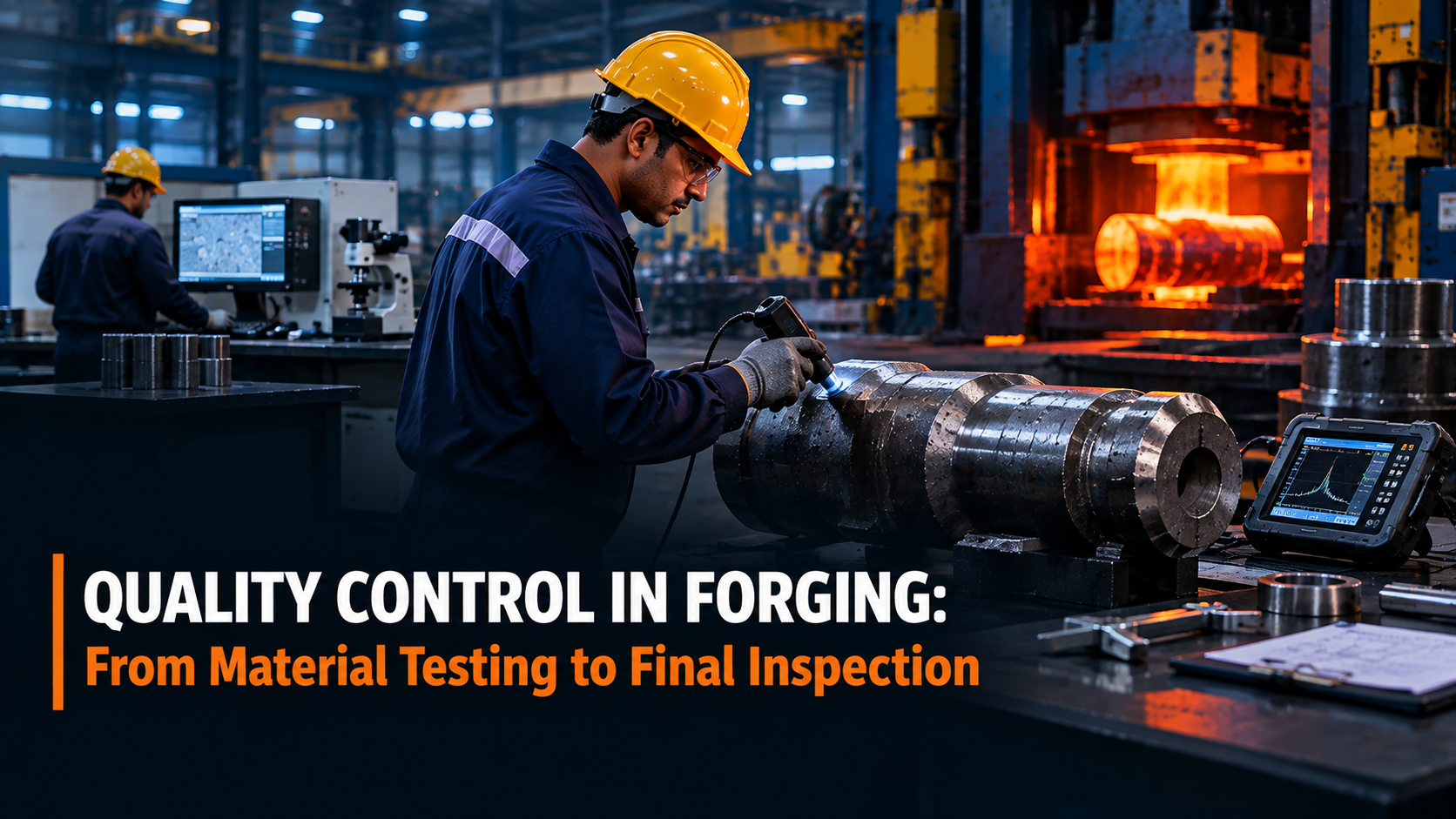
Non-destructive testing verifies sound internal and surface structure without compromising the workpiece. Inquire whether the manufacturer possesses certified ASNT Level II inspectors capable of executing Ultrasonic Testing (UT) for volumetric soundness, Magnetic Particle Inspection (MPI) for surface and near-surface cracks, and Liquid Penetrant (LP/DP) testing for non-ferrous and complex geometries.
5. Machining Capability
If machining is required after forging, an integrated supplier can simplify production coordination.
Integrated Single-Source Responsibility
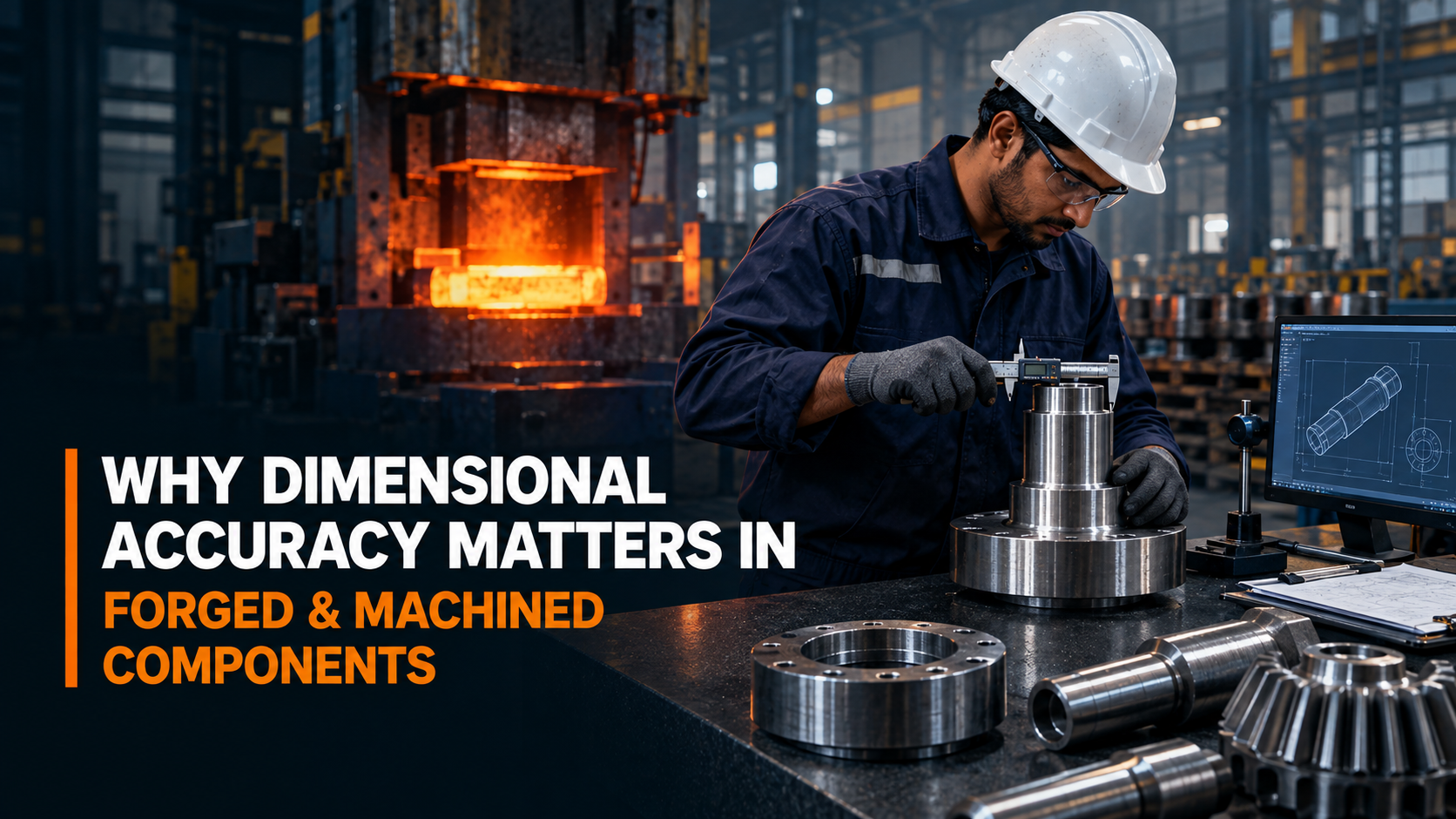
Shipping black forgings to an external third-party machine shop introduces logistical delays, freight costs, and the risk of finger-pointing if a flaw is discovered beneath the forged skin during finishing. A manufacturer with in-house rough proof-machining and precision finish CNC machining assumes complete single-point accountability for final dimensional compliance.
6. Industry Experience
Experience with your industry and application can help reduce manufacturing challenges.
Application-Specific Metallurgy
An aerospace turbine disc, an oilfield blowout preventer block, a heavy mining gear blank, and an automotive transmission shaft have vastly distinct operating demands. A supplier with proven experience across diverse sectors understands critical defect thresholds, grain orientation requirements, and appropriate heat treatment cycles (Normalizing, Annealing, or Q&T).
Supplier Evaluation Matrix for Engineering Buyers
When auditing prospective forging manufacturers, use this quick checklist to guide technical evaluations:
| Evaluation Factor | Key Questions to Ask | Preferred Manufacturer Standard |
|---|---|---|
| Process & Tooling | Do you offer Open Die or Closed Die? Can you forge prototypes without tooling charges? | Pneumatic hammer capacity up to 1500 kg for flexible open die custom geometries. |
| Size & Envelope | What are your maximum diameter, length, and individual piece weight ratings? | Diameters up to 800 mm and piece weights up to 500 kg with uniform reduction ratios. |
| Quality & Lab | Are your quality systems third-party certified? Do you have in-house testing labs? | ISO 9001:2015 by TUV NORD; NABL-accredited in-house metallurgical testing. |
| Non-Destructive Exam | Can you perform 100% volumetric UT, MPI, and dye penetrant testing in-house? | Qualified ASNT Level II inspectors performing UT, MPI, and LP/DP to ASTM/EN specs. |
| Downstream Machining | Do you provide proof machining and finished CNC machining under the same roof? | Integrated proof and CNC machining facilities for single-source accountability. |
| Industry Reputation | Who are your tier-1 OEM clients and raw material steel suppliers? | Trusted by leaders like Regal Rexnord, Ringfeder, Valveworks, and Eicher. |
Forgewell Industries: An Integrated Manufacturing Partner
Forgewell Industries combines forging, machining, heat treatment and quality inspection capabilities to support industrial customers with an integrated manufacturing approach.
Founded in 2010 in Pune, Maharashtra, Forgewell Industries operates two advanced production units engineered to take components smoothly from prime raw billet through to finished, inspection-ready engineering parts. Rather than acting as a disjointed subcontractor, Forgewell operates as a collaborative engineering partner:
- Open Die Pneumatic Hammers: Capacities up to 1500 kg producing forged shafts, rings, discs, and blocks up to 800 mm diameter and 500 kg per piece.
- Certified Raw Material Sourcing: Prime certified billets exclusively sourced from Tier-1 steel producers including SAIL, Saarloha, Bajaj Mukand, and Nippon Steel.
- In-House Downstream Processing: Proof-machining, thermal heat treatment cycles (Normalizing, Annealing, Q&T, Stress Relieving), and precision CNC finish machining.
- Comprehensive Inspection: Dimensional metrology, mechanical tensile/impact testing, optical emission spectrometry, and Level II UT/MPI/DP examination.
Looking for a forging partner? Start with your component requirement and let the manufacturing process follow.