Forged products come in many forms depending on the requirements of the application.
Across heavy industrial engineering—including power generation, marine propulsion, steel rolling mills, mining equipment, cement kilns, and defense manufacturing—components are subjected to extreme torsional stresses, continuous cyclic impact, high pressure, and abrasive environments. Where cast parts risk catastrophic failure due to internal shrinkage or porosity, and standard rolled bar stock lacks directional toughness along complex profiles, open die forging delivers consolidated density, unbroken grain flow, and superior fatigue life across three essential geometric families: Shafts, Rings, and Blocks.
Forged Shafts
Shafts are widely used for transmitting torque and rotational loads. Forging can provide the strength and structural characteristics required for demanding applications.
In power transmission assemblies, rotating shafts endure severe combinations of pure torsional shear, bending moments, and cyclic reverse fatigue. Forged step shafts and round bars provide critical mechanical advantages over subtractive machining from plain stock:
Continuous Grain Flow in Stepped Shafts
When step shafts are machined out of generic cylindrical stock, the straight metallurgical grain lines are severed at every diameter transition, creating microscopic stress risers prone to fatigue initiation. In contrast, open die forging uses specialized tooling to forge the stepped profiles directly, forcing internal grain flow lines to follow the contours and blend radii of every collar and shoulder.
This results in elevated torsional fatigue limits, superior shear resistance, and exceptional resistance to shock loading during start-stop industrial cycles.
- Common Shaft Profiles: Single and multi-stepped shafts, pinion shafts, eccentric shafts, rotor shafts, turbine shafts, and forged round bars up to 800 mm in diameter.
- Key Industrial Applications: Industrial gearbox output shafts, crane drive axles, rolling mill drive spindles, pump impellers, turbine rotors, and marine propulsion shafts.
Forged Rings
Forged rings are used in various engineering applications where robust circular components are required.
Whether in heavy slewing mechanisms, high-pressure pipeline connections, or power plant turbines, circular components face intense hoop stress, internal fluid pressure, and radial shock. Forged seamless rings offer unmatched structural integrity compared to rolled-and-welded or plate-cut alternatives:
Seamless Circular Strength Without Weld Seams
Forged rings are manufactured by upsetting a solid billet, piercing a central hole, and expanding the material circumferentially over a saddle mandrel. This expansion aligns the metallurgical grain lines in a continuous, unbroken concentric orientation around the entire circumference of the ring.
Eliminating welded heat-affected zones (HAZ) and directional plate laminations ensures uniform tangential tensile strength, superior notch toughness, and predictable response to subsequent quenching and tempering.
- Ring Geometries: Heavy-wall forged rings, contoured bearing races, gear rim blanks, blind flanges, and spacer rings proof-machined to close tolerances.
- Key Industrial Applications: Heavy slewing ring bearings, wind turbine yaw rings, API 6A high-pressure oil & gas flanges, bull gear blanks, pressure vessel nozzle flanges, and valve bodies.
Forged Blocks
Blocks can serve as starting forms for further machining or as finished components depending on the application.
In applications requiring intricate internal fluid passages, deep cavity milling, or multi-directional mechanical loading, forged rectangular and square blocks provide sound volumetric density throughout their cross-section:
Multi-Directional Upsetting & Isotropic Properties
Heavy pneumatic hammers subject the starting steel block to extensive multi-axis upsetting and cross-forging. This heavy reduction consolidates the center core of the ingot, breaking down cast dendrites and fusing center-line shrinkage pockets.
When machinists execute deep gun-drilling or complex cavity milling into the block, there is zero risk of intercepting internal voids, porosity, or alloy segregation, ensuring leak-tight performance under extreme hydraulic working pressures.
- Block Configurations: Rectangular blocks, square forged blocks, die blocks, forged slabs, and proof-machined manifold blanks.
- Key Industrial Applications: High-pressure hydraulic manifold blocks, plastic injection mold bases, hot-work forging dies, extrusion tooling, and high-pressure fluid ends for triplex pumps.
Comparative Analysis: Shafts vs. Rings vs. Blocks
A quick technical reference comparing the three core product categories across heavy engineering:
| Product Category | Grain Flow Orientation | Primary Stress Resistances | Typical Steel Grades |
|---|---|---|---|
| Forged Shafts | Axial & radial contours through steps | Torsional shear, cyclic bending, dynamic reverse fatigue | EN8, EN9, EN19, EN24, 42CrMo4, 20MnCr5, 304L/316L |
| Forged Rings | Continuous circumferential loop | Radial hoop stress, internal fluid pressure, tangential fatigue | ASTM A105, A350 LF2, AISI 4140, 4340, SS 316, F22, F51 |
| Forged Blocks | Multi-directional, consolidated volumetric | Multi-axial bursting pressure, high compressive impact, thermal fatigue | AISI 4130, P20, DIN 1.2714, H13, D2, C45, 17-4 PH |
Why Product Design Matters
The appropriate forging process depends on a series of interdependent engineering parameters:
Component Dimensions
Cross-sectional thickness and total piece weight govern the required hammer energy, reduction ratios, heating furnace capacity, and handling manipulator sizing.
Material Selection
Alloy composition dictates the plastic deformation window, forging resistance, heat treatability (quench severity), and atmospheric oxidation characteristics.
Geometry & Tooling
Complex steps, transitions, draft angles, and inner bores determine whether open die, semi-closed die, or mandrel-assisted tooling provides optimal material yields.
Production Quantity
Batch volumes drive process economics; low-to-medium volume heavy parts benefit enormously from open die forging due to zero die-tooling tooling costs and rapid turnaround.
Required Mechanical Properties
Specified tensile strength, yield limits, Charpy impact toughness at sub-zero temperatures, and hardness dictate downstream thermal processing parameters.
Machining Requirements
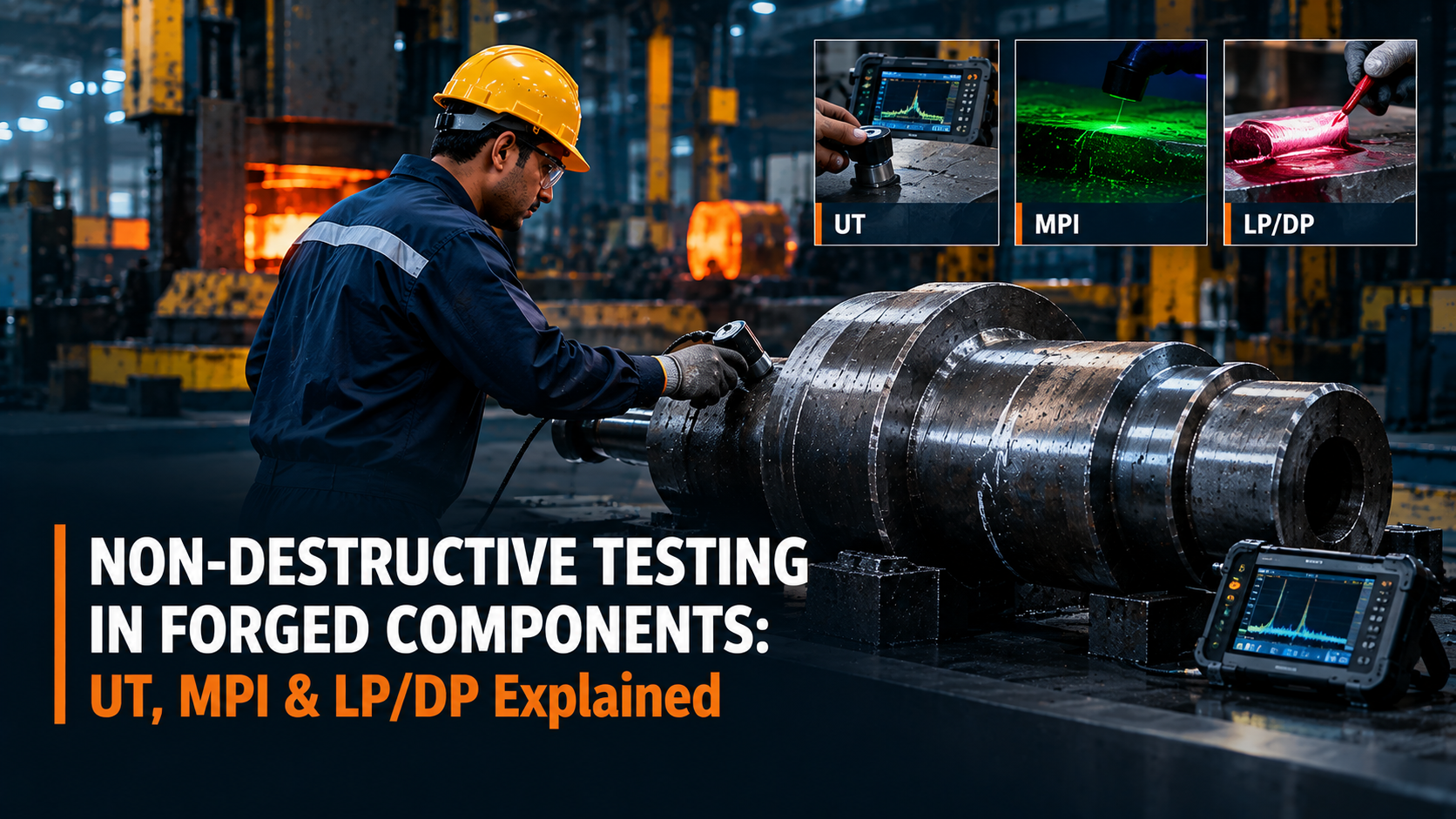
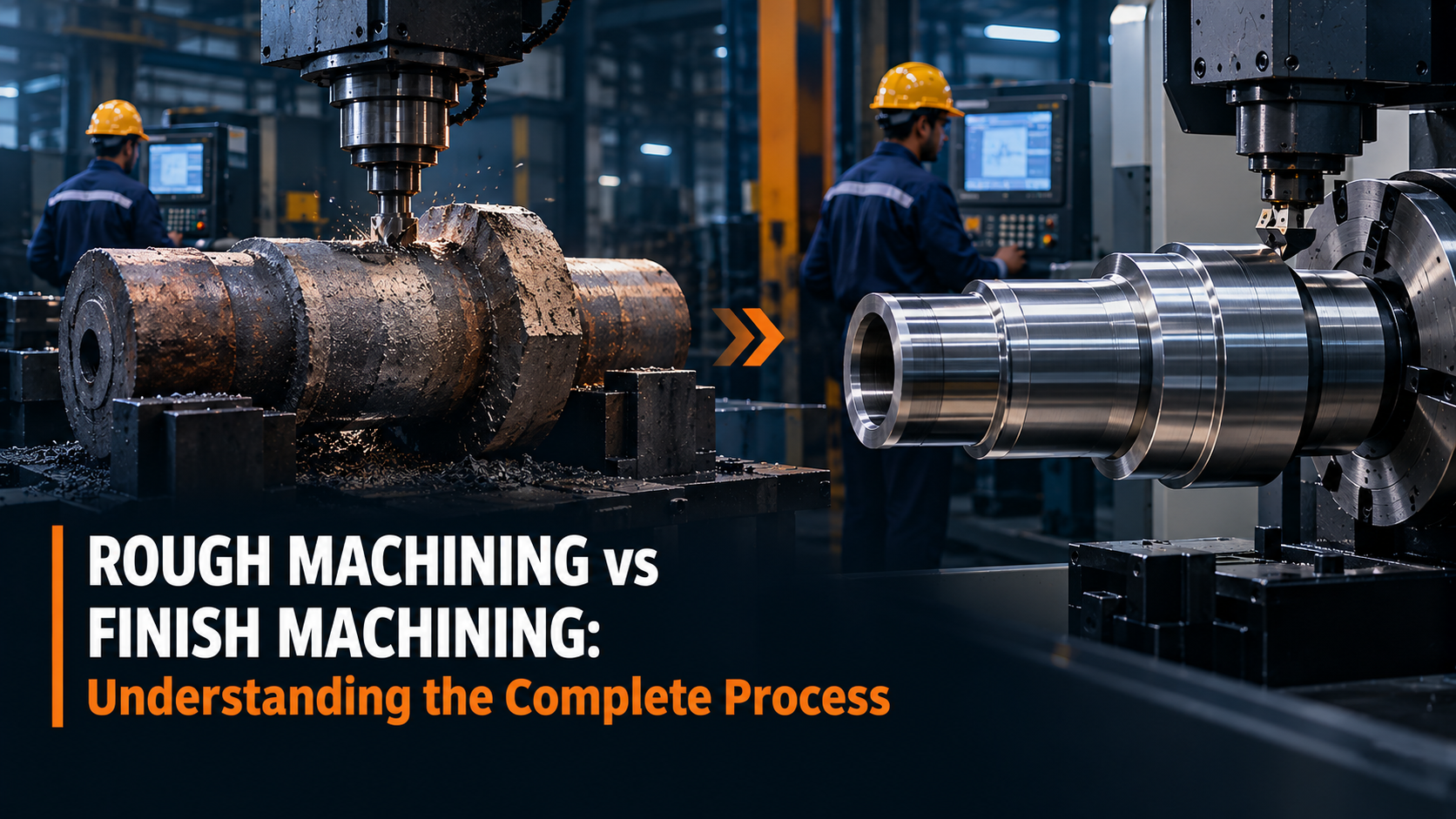
Engineered proof-machining allowances ensure sufficient stock remains to eliminate decarburization and surface scale while easing 100% volumetric Ultrasonic Testing.
Forgewell Industries: Comprehensive Forging Solutions
Forgewell Industries supports customers with forging and downstream manufacturing capabilities to develop components suited to their application.
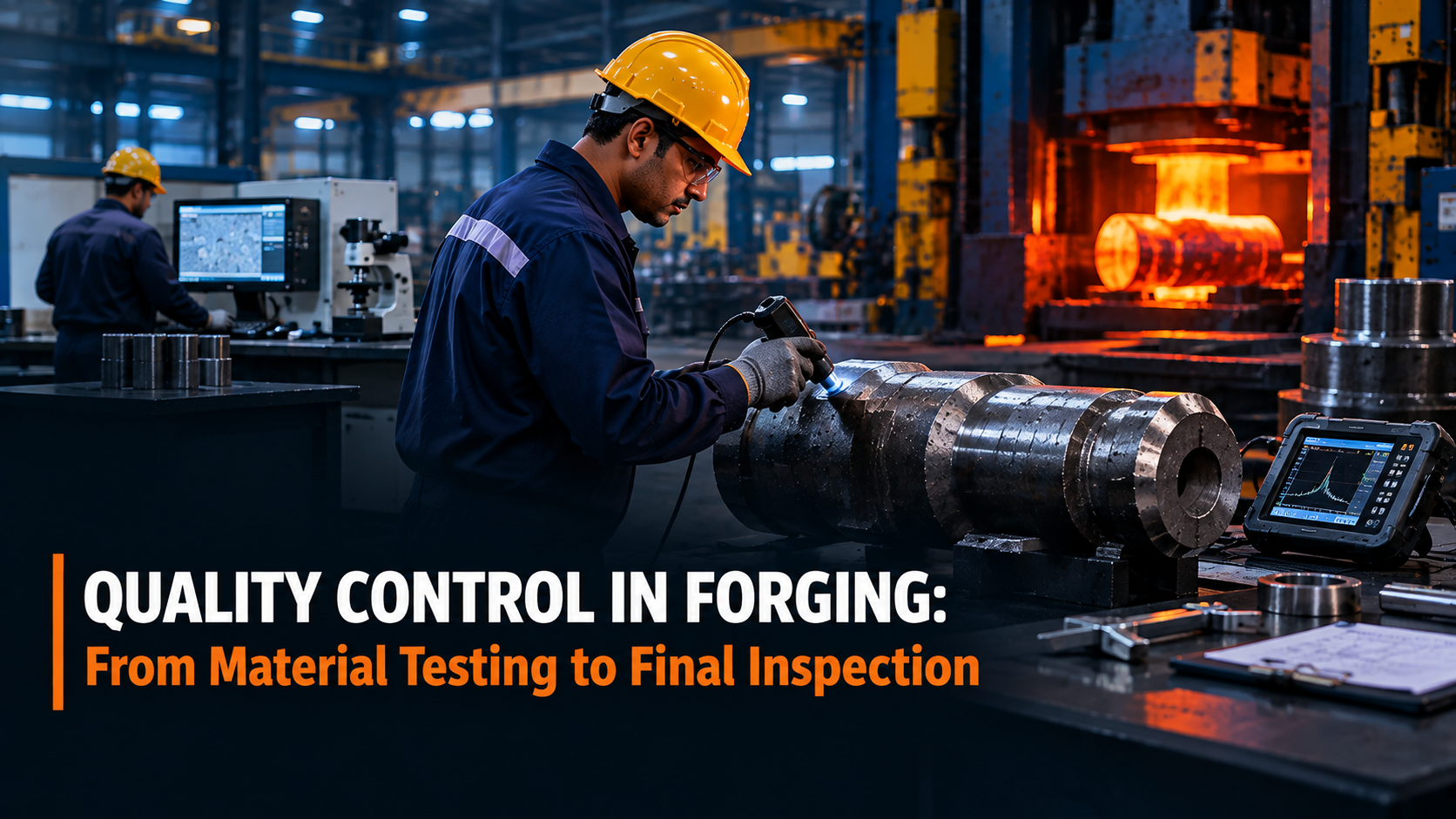
Equipped with open die pneumatic hammers up to 1500 kg, dual manufacturing units in Pune, and an integrated manufacturing ecosystem, Forgewell delivers forged round bars, step shafts, rings, blocks, blanks, and semi-closed die parts up to 800 mm in diameter and 500 kg per piece. By combining raw billet sourcing with open die forging, certified heat treatment (Normalizing, Annealing, Q&T), in-house proof machining, and NABL-traceable NDT inspection, we provide completely finished, ready-to-assemble solutions tailored to customer drawings.
Forgewell Industries — Engineered Forgings for Heavy Engineering.