Forged components play an important role in industries where component reliability is critical.
Across high-performance sectors—including automotive mobility, defense armament, civil and military aerospace, heavy mining and construction machinery, and energy infrastructure—component failure is never an acceptable risk. Whether facing extreme cyclic fatigue in an automotive transmission, ballistic shock in an armored combat platform, high-altitude thermal gradients in an aircraft engine assembly, or thousands of tons of continuous torque in an industrial rolling mill, forged components provide the unbroken metallurgical grain flow, structural density, and isotropic mechanical toughness required to guarantee operational uptime.
Automotive
Forging is used for various high-load components requiring strength and durability.
Modern automotive platforms—both internal combustion and next-generation commercial electric vehicle (EV) drivetrains—place continuous mechanical demands on rotating and load-bearing mechanisms. High power density, rapid acceleration torque, and lightweight chassis goals mandate materials with superior strength-to-weight ratios:
High-Cycle Fatigue & Powertrain Integrity
Components like transmission input/output shafts, stepped stub axles, steering knuckles, and differential gear blanks undergo billions of reverse torsional and bending cycles. Forging continuously contours metallurgical grain lines along fillets, transitions, and bearing journals, eliminating notch sensitivity and drastically elevating fatigue thresholds compared to cast equivalents.
Case-hardening alloy steels like 20MnCr5, 16MnCr5, and 8620 respond uniformly during subsequent carburizing and quenching, ensuring a diamond-hard, wear-resistant surface alongside a shock-absorbing ductile core.
Defence
Defence equipment can demand robust components capable of performing under demanding conditions.
Military hardware operating on land, sea, and air encounters harsh ballistic shock, rough off-road terrain, high-velocity artillery impulses, and aggressive maritime environments. Defence procurement mandates zero-tolerance for material discontinuities:
Ballistic Impact Resistance & Volumetric Soundness
Armored personnel carriers, battle tanks, and tactical artillery rely on forged torsion bars, heavy drive sprockets, breech mechanism blocks, suspension links, and gun barrel blanks. These components must absorb extreme kinetic shock waves without brittle fracturing.
By utilizing high-reduction forging (minimum 3:1 to 4:1 ratios) on vacuum-degassed or electro-slag remelted (ESR) alloy steels, open die forging consolidates center-line density, ensuring 100% sound volumetric integrity under rigorous Ultrasonic Testing (UT).
Aerospace
Aerospace components require strict control of material, dimensional and quality requirements.
In aerospace manufacturing, components operate at the threshold of structural materials engineering. Flight safety mandates flawless metallurgical cleanliness, zero internal micro-voids, and strict adherence to international AMS/AS9100 quality guidelines:
Strict Pyrometry, Cleanliness & Precision Tolerances
Aircraft landing gear cylinders, structural engine mounts, rotor hubs, turbine shaft blanks, and wing attachment fittings must endure high static loads, high thermal differentials, and severe vibration. Premium specialty alloys—such as precipitation-hardening stainless steels (17-4 PH, 15-5 PH), titanium, and nickel superalloys—require strict atmospheric and furnace pyrometry control.
Multi-axis forging refines austenitic grain boundaries (ASTM E112 Rating 5–8) and ensures uniform mechanical properties across X, Y, and Z axes, preventing directional grain drop-off during high-G maneuvers.
Heavy Engineering
Large machinery and industrial equipment often require strong forged components for structural and mechanical applications.
Heavy capital equipment used in steel rolling mills, cement kilns, mining draglines, heavy hydraulic presses, and overhead port cranes handle thousands of tons of continuous mechanical load under punishing round-the-clock operations:
Massive Load-Bearing Capacity & Wear Endurance
In heavy processing plants, an unexpected spindle fracture or crane axle shear causes millions in plant shutdown losses. Open die forged shafts up to 800 mm in diameter, forged rings, and heavy bolster blocks provide the massive impact toughness and continuous yield strength needed to resist severe continuous shock.
Alloy grades like 42CrMo4, EN19, EN24, and tool steel blocks are forged under heavy pneumatic hammers to eliminate residual cast porosity, followed by proof-machining and certified ultrasonic inspection.
Power & Industrial Applications
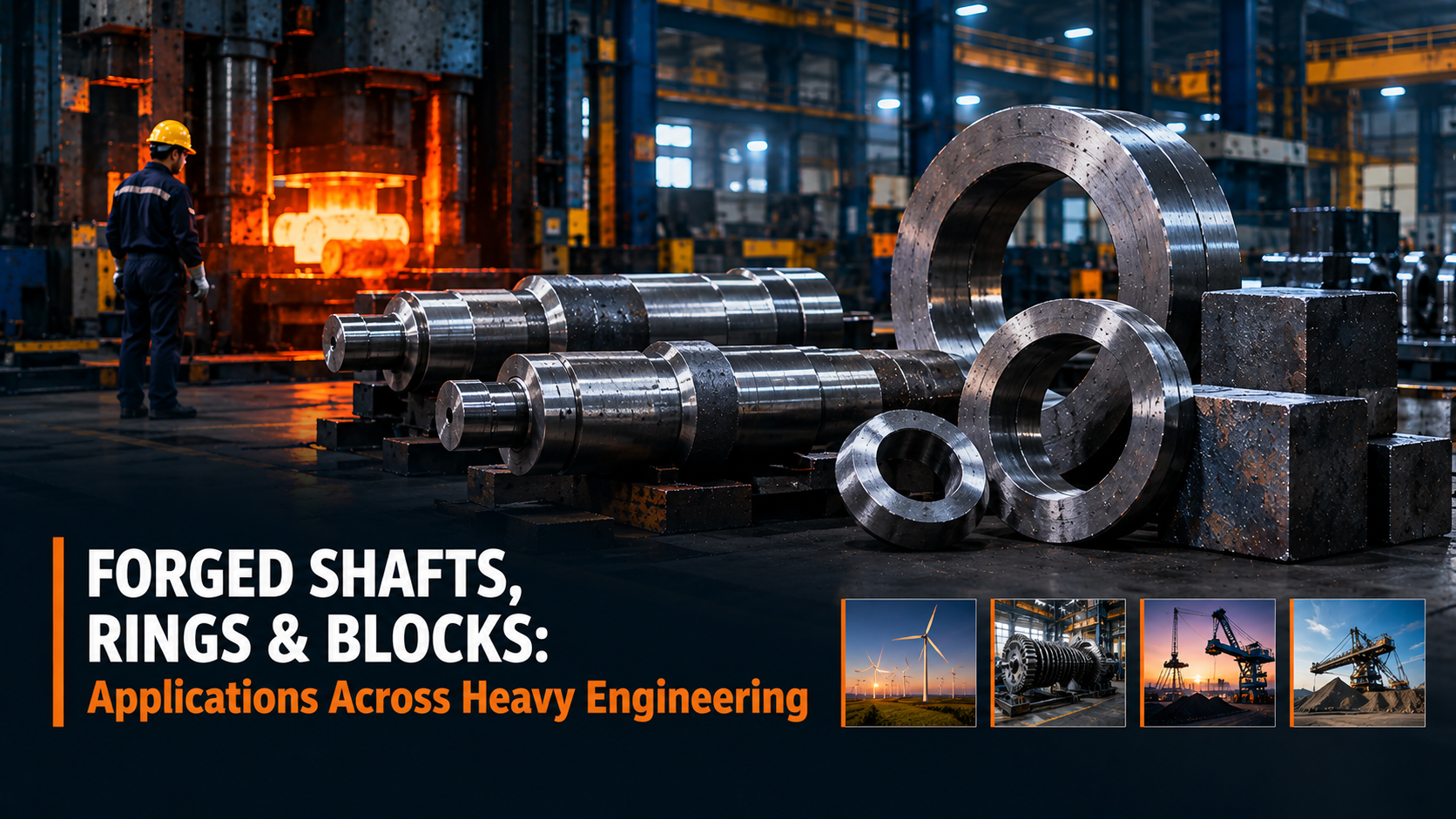
Forged shafts, rings, blocks and other components can be used in equipment involving high loads and demanding operating environments.
Energy systems and process industries impose multi-faceted operational stresses, from high working pressures to sub-zero cryogenic fluid transport:
- Thermal & Hydroelectric Power: Steam turbine rotor shafts, generator couplings, governor valve bodies, and Francis/Pelton runner blanks requiring elevated creep resistance and fatigue endurance.
- Wind Energy: High-torque wind turbine main drive shafts, yaw bearing rings, pitch slewing gear rims, and generator hub shafts enduring relentless turbulent wind gusts.
- Oil, Gas & Subsea Processing: API 6A / 17D high-pressure wellhead valve blocks, forged blind and weld-neck flanges, and manifold blocks in ASTM A350 LF2, F22, and duplex stainless steels (F51/F53) designed to prevent hydrogen embrittlement and sulfide stress cracking.
Industry Applications & Material Matrix
A technical cross-reference overview of key industrial applications and their forging parameters:
| Industry Sector | Benchmark Forged Components | Critical Operating Demands | Typical Steel & Alloy Grades |
|---|---|---|---|
| Automotive | Transmission shafts, step axles, steering knuckles, pinion blanks | High-cycle fatigue strength, wear resistance, dimensional precision | 20MnCr5, 16MnCr5, SAE 8620, EN8D, AISI 4140 |
| Defence | Torsion bars, track pins, gun barrel blanks, breech blocks, sprockets | High ballistic impact shock, fracture toughness, zero internal defects | EN24, AISI 4340, ESR Remelted Ni-Cr-Mo Steels, 30CrNiMo8 |
| Aerospace | Landing gear cylinders, engine mounts, rotor hubs, structural fittings | Strict cleanliness (AMS), high strength-to-weight, corrosion resistance | 17-4 PH, 15-5 PH, AISI 4340 VIM-VAR, Inconel 718, SS 316L |
| Heavy Engineering | Rolling mill spindles, crane axles, eccentric shafts, die blocks | Massive load bearing, continuous torque, high wear and shear resistance | 42CrMo4, EN19, EN24, C45, DIN 1.2714, AISI 4130 |
| Power & Energy | Turbine shafts, API 6A valve bodies, wellhead blocks, slewing rings | High internal pressure, sub-zero Charpy toughness, sour gas resistance | ASTM A105, A350 LF2, F22, F51 Duplex, AISI 4130 (75K) |
Forgewell Industries: Manufacturing Excellence for Diverse Sectors
With Open Die and Closed Die Forging capabilities supported by machining, heat treatment and inspection, Forgewell can cater to diverse industrial requirements.
Forgewell Industries operates two manufacturing units in Pune, Maharashtra, engineered specifically to serve global OEMs across these vital industrial sectors. Our facilities house pneumatic hammers up to 1500 kg, capable of producing open die forged shafts, rings, blocks, and blanks up to 800 mm in diameter and 500 kg per piece. Supported by in-house proof machining, calibrated thermal processing furnaces (Normalizing, Annealing, Q&T), and NABL-accredited metallurgical and NDT inspection labs (100% UT per ASTM A388), we provide fully certified, ready-to-install components built for uptime.
Forgewell Industries — Engineered Forgings for Critical Global Industries.