
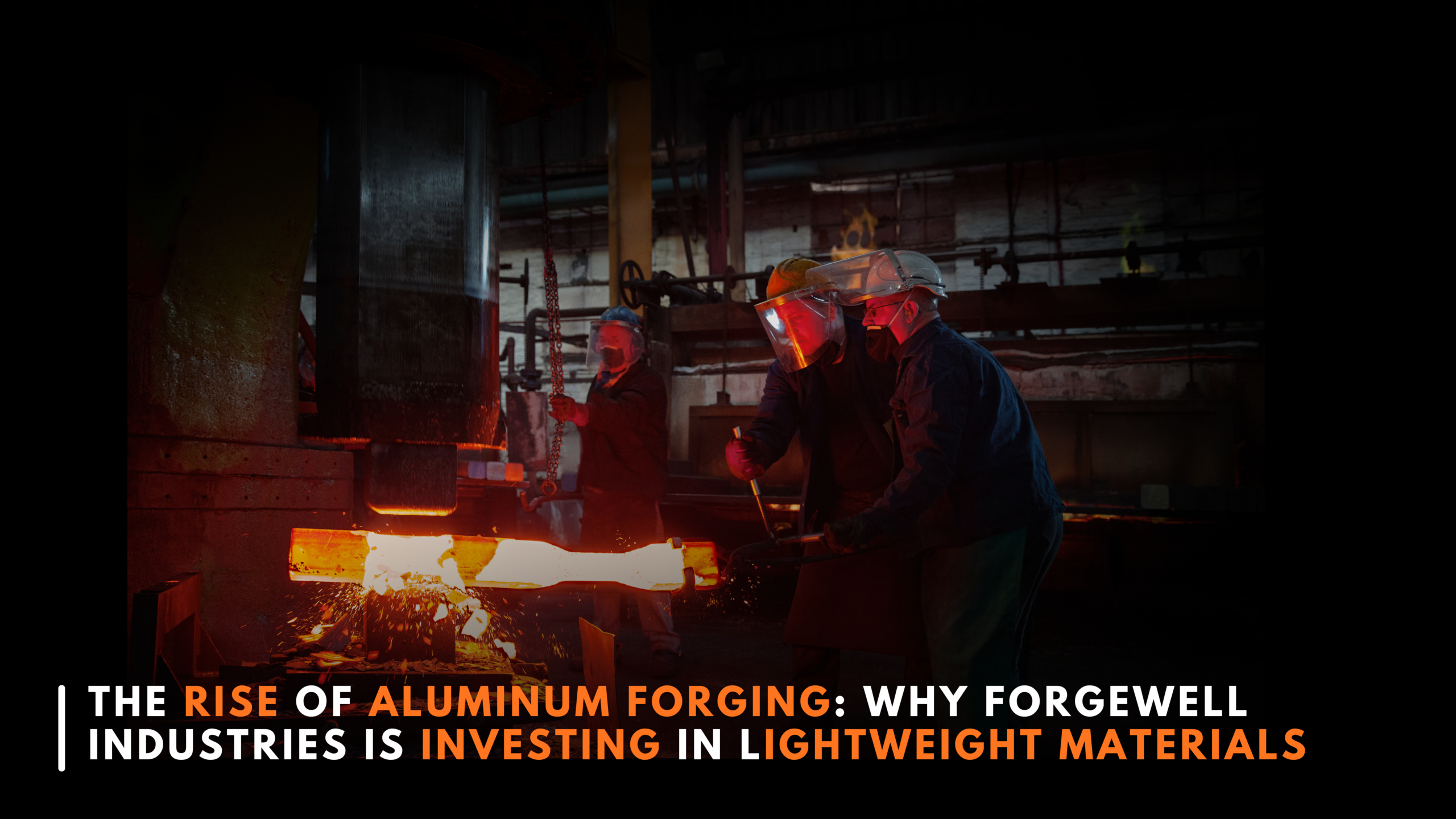
The Rise of Aluminum Forging: Why Forgewell Industries is Investing in Lightweight Materials
Introduction: The Lightweight Revolution in Manufacturing
The manufacturing industry is experiencing a fundamental shift toward lightweight materials, driven by fuel efficiency regulations, electric vehicle adoption, and sustainability initiatives. Aluminum forging stands at the center of this transformation, offering exceptional strength-to-weight ratios that make it ideal for modern applications. Forgewell Industries recognizes this trend and is strategically investing in aluminum forging capabilities to serve evolving customer needs.
Understanding the Aluminum Advantage
Weight Savings Without Compromise
Aluminum’s density (approximately 2.7 g/cm³) is roughly one-third that of steel (7.85 g/cm³), enabling dramatic weight reductions. A component weighing 10 kg in steel might weigh only 3.5 kg in aluminum while maintaining comparable strength through optimized design.
For automotive applications, this translates to:
- Improved fuel efficiency (approximately 6-8% improvement per 10% weight reduction)
- Enhanced vehicle performance and handling
- Extended electric vehicle range
- Reduced emissions across the vehicle lifecycle
Forging Aluminum: Special Considerations
Aluminum forging differs from steel forging in several important ways:
Temperature Ranges: Aluminum alloys forge at much lower temperatures (350-500°C) compared to steel (1000-1250°C), requiring different equipment setups but consuming less energy.
Material Flow: Aluminum’s lower melting point and different crystal structure affect how it flows during forging, necessitating specialized die design.
Surface Treatment: Aluminum naturally forms a protective oxide layer, but forged components often require anodizing or other surface treatments for enhanced corrosion resistance and wear properties.
Heat Treatment: Many aluminum alloys derive their strength from precipitation hardening (aging) after solution heat treatment, requiring precise thermal processing.
The Market Opportunity for Aluminum Forging
Rapid Market Growth
The aluminum forging segment is expanding faster than overall forging markets, with 8.4% annual growth projected through 2030. This outpaces traditional steel forging (6.5% CAGR), reflecting the automotive industry’s urgent need for weight reduction.
Key Application Sectors
Automotive Industry: The largest market for aluminum forgings, driven by Corporate Average Fuel Economy (CAFE) standards and electric vehicle penetration.
Aerospace: Aluminum has dominated aerospace applications for decades, with continued demand for airframe components, landing gear elements, and structural fittings.
Industrial Machinery: Aluminum forgings reduce equipment weight while maintaining strength, improving transportability and reducing foundation requirements.
Electronics: Aluminum’s thermal conductivity makes it valuable for heat sinks, housings, and structural components in electronic equipment.
Renewable Energy: Wind turbine components, solar panel mounting systems, and other renewable energy infrastructure use aluminum forgings.
Manufacturing Process for Aluminum Forgings
Material Preperation
Starting with cast billets or rolled bars, material preparation includes:
1.Homogenization heat treatment to reduce chemical segregation
2.Cutting to appropriate billet size
3.Preheating to forging temperature
Forging Operations
Closed-Die Forging: Produces near-net-shape parts with excellent detail and surface finish. Most aluminum forgings use closed-die process for dimensional accuracy and material utilization.
Process Control: Critical parameters include:
1.Die temperature management (warm dies prevent excessive chilling)
2.Forging speed (aluminum's lower strength allows faster press speeds)
3.Lubricant selection (specialized lubricants for aluminum)
4.Flash control (minimizing excess material)
Post - Forge Processing
Solution Heat Treatment: Heating above the solvus temperature dissolves strengthening elements into solid solution.
Quenching: Rapid cooling (usually in water) locks in the supersaturated solid solution.
Aging: Natural aging (T4) occurs at room temperature, or artificial aging (T6) uses elevated temperature (150-190°C) to precipitate strengthening phases.
Machining: CNC operations bring components to final dimensions and surface finish requirements.
Surface Treatment: Anodizing, chemical conversion coating, or painting as specified.
Quality Considerations for Aluminum Forging
Dimensional Stability
Aluminum's thermal expansion coefficient (approximately twice that of steel) requires careful consideration:
1.Stabilization heat treatments prevent dimensional changes
2.Temperature control during machining maintains accuracy
3.Fixtures account for thermal expansion
Surface Quality
Aluminum's soft surface requires protective treatments:
1.Hard anodizing for wear resistance
2.Chemical film coating for corrosion protection
3.Painting or powder coating for appearance and protection
Mechanical Properties
Testing ensures proper heat treatment:
1.Tensile strength verification
2.Hardness testing (Brinell or Rockwell B scales)
3.Conductivity testing (indicates heat treatment condition)
4.Grain structure examination via metallography
Electric Vehicle Applications Driving Aluminum Demand
Battery System Components
Electric vehicle battery packs require structural support, thermal management, and crash protection:
Battery Tray Structures: Aluminum forgings provide strong mounting points with minimal weight penalty.
Cooling System Components: Aluminum's thermal conductivity makes it ideal for heat exchangers and coolant manifolds.
Mounting Brackets: Secure battery modules while allowing thermal expansion and contraction.
Crash Protection: Energy-absorbing structures protect expensive battery cells during impacts.
Motor & Power Brackets
Motor Housings: Aluminum forgings provide robust mounting while dissipating heat from electric motors.
Inverter Enclosures: House sensitive power electronics with EMI shielding and thermal management.
Mounting Structures: Support heavy motors and power electronics while maintaining alignment.
Chasis & Suspension
Control Arms: Aluminum forged control arms reduce unsprung weight, improving ride quality and handling.
Knuckles: Steering knuckles in aluminum maintain strength while reducing mass.
Suspension Components: Springs seats, mounting brackets, and links benefit from aluminum's weight savings.
Structural Components
Subframe Assemblies: Aluminum forgings create strong attachment points in composite or aluminum subframes.
Crash Structures: Energy-absorbing forgings protect occupants while meeting lightweighting targets.
Sustainability Benefits of Aluminum
Recyclability
Aluminum is infinitely recyclable without property degradation:
- Recycling requires only 5% of the energy needed for primary aluminum production
- Scrap from forging operations returns to the supply chain
- End-of-life vehicles contribute to aluminum recycling streams
Lifecycle Analysis
While primary aluminum production is energy-intensive, lifecycle analysis shows:
- Weight savings reduce fuel consumption or extend EV range
- Emissions reductions during vehicle use often exceed production emissions
- Recyclability reduces long-term environmental impact
Circular Economy
Aluminum's recyclability supports circular economy principles:
- Closed-loop recycling from automotive applications
- Material recovery from manufacturing scrap
- Long service life with corrosion resistance
Forgewell Industries implements sustainable practices including scrap segregation, return of machining chips to aluminum suppliers, and energy-efficient processing.
Investment Requirements for Aluminum Forging
Equipment Considerations
Forging Presses: Aluminum's lower flow stress allows use of lower-capacity presses compared to steel, but dedicated aluminum presses prevent cross-contamination.
Heat Treatment Facilities: Solution treating and aging ovens with precise temperature control and appropriate atmosphere.
Machining Equipment: Aluminum-optimized CNC machines with higher spindle speeds and appropriate coolant systems.
Surface Treatment: Anodizing or coating facilities, or partnerships with specialized processors.
Technical Expertise
Successful aluminum forging requires knowledge in:
- Alloy selection and material properties
- Die design for aluminum's flow characteristics
- Heat treatment metallurgy
- Quality control specific to aluminum
Forgewell Industries' investment in aluminum forging includes both equipment capabilities and technical training, ensuring we can deliver high-quality aluminum components meeting demanding specifications.
Cost Considerations
Material Costs
Aluminum's higher per-kilogram cost compared to steel is partially offset by:
- Lower weight requirements for equivalent performance
- Reduced transportation costs for lighter components
- Lower energy consumption during forging
- Premium pricing justified by performance benefits
Total Cost of Ownership
Customers increasingly evaluate total cost including:
- Improved fuel efficiency or EV range
- Reduced warranty costs from corrosion
- Easier handling and assembly
- Potential for design simplification
Forgewell Industries’ Aluminum Forging Strategy
Capability Development
Our strategic approach includes:
Equipment Investment: Dedicated aluminum forging capabilities with appropriate presses, heat treatment, and machining equipment.
Material Partnerships: Relationships with aluminum suppliers ensuring consistent quality and availability.
Technical Expertise: Training staff in aluminum-specific processes and quality requirements.
Quality Systems: Procedures and controls addressing aluminum’s unique characteristics.
Target Markets
Focus on applications where aluminum forging provides clear advantages:
- Electric vehicle components for automotive OEMs
- Performance automotive applications
- Industrial equipment requiring weight reduction
- Aerospace and defense opportunities
Customer Collaboration
Working with customers from design stage:
- Material selection guidance
- Design optimization for aluminum properties
- Cost-benefit analysis
- Prototyping and testing support
Future Outlook for Aluminum Forging
Continued Growth Drivers
Electrification: Global EV adoption continues accelerating, driving aluminum demand.
Regulatory Pressure: Fuel economy and emissions regulations maintain lightweighting imperative.
Technology Advancement: New aluminum alloys and processing techniques expand application possibilities.
Cost Reduction: Increasing aluminum recycling and production efficiency improve cost competitiveness.
Emerging Technologies
Aluminum-Lithium Alloys: Ultra-lightweight alloys for aerospace and premium automotive applications.
Hybrid Structures: Combining aluminum forgings with composites or other materials.
Additive Manufacturing Integration: Using forged blanks with additive manufacturing for complex features.
Conclusion
Aluminum forging represents a strategic growth opportunity driven by fundamental industry trends toward lightweighting, electrification, and sustainability. The 8.4% annual market growth reflects strong demand across automotive, aerospace, and industrial sectors.
Forgewell Industries is investing in aluminum forging capabilities to serve customers requiring lightweight, high-strength components. Our Pune-based facility combines expertise in precision forging with CNC machining capabilities, enabling us to deliver complete aluminum component solutions.
As India’s manufacturing sector evolves toward high-value applications, aluminum forging positions Forgewell Industries for growth in electric vehicles, aerospace, and advanced industrial applications. Our commitment to quality, technical excellence, and customer partnership ensures we can meet the demanding requirements of aluminum forging customers.